Problem
Editing, tools, context and agent delegation become difficult to follow when each lives behind a different interface.
Public · 4.6.0
Terminal IDE and AI-agent operator surface with local memory, inspectable tools and explicit delegation.
Source-based case study
Documentation review · observed 2026-09-08 · no new runtime test
Editing, tools, context and agent delegation become difficult to follow when each lives behind a different interface.
The public README documents six packages with separate responsibilities: the terminal interface, core configuration, skills, orchestration, local memory and tools. The operator stays close to editing, Git and explicit handoffs.
The inspected source documents a Textual terminal IDE with a file tree, multi-tab editing, LSP integration, a terminal and agent diff preview. The observed package version is 4.6.0. These are source-backed capabilities, not results of a new runtime benchmark.
BrierAinz / BrierStudios publishes this operator interface separately from private orchestration. The source provides the inspectable artifact; its effectiveness on a particular workflow still requires a reproducible runtime test.
This case reviews the public source and its design boundary. It does not claim that a private Yggdrasil deployment was accessed, that every integration was executed or that this review measured productivity gains.
Inspect the pinned source · 003d45fd5fe0
AI tooling becomes difficult to audit when editing, tools, memory and model delegation are split across opaque products.
Lilith CLI keeps editor workflows, LSP, git-oriented tooling, local memory and tool/model delegation close to the operator.
A public operator surface whose source can be inspected independently from private integrations.
Public repository and package version are represented through verified evidence records.
Selected case studies
Terminal IDE and AI-agent operator surface with local memory, inspectable tools and explicit delegation.
AI tooling becomes difficult to audit when editing, tools, memory and model delegation are split across opaque products.
Lilith CLI keeps editor workflows, LSP, git-oriented tooling, local memory and tool/model delegation close to the operator.
The public repository does not make the private Yggdrasil workspace public.
Verified Project State · 16.1
Public repository and package version are represented through verified evidence records.
Within review window · Review window: 30 days
Source activity, the date of review and the website release are different events. A new website release does not renew this project’s evidence.
Open the dated state ledgerProject Intelligence 3 · 2026-08-18
Operator reliability, inspectable delegation and local-first developer workflows.
Public software remains the independently inspectable operator surface while private orchestration stays outside the website boundary.
Updated 2026-08-18 · 30d freshness window
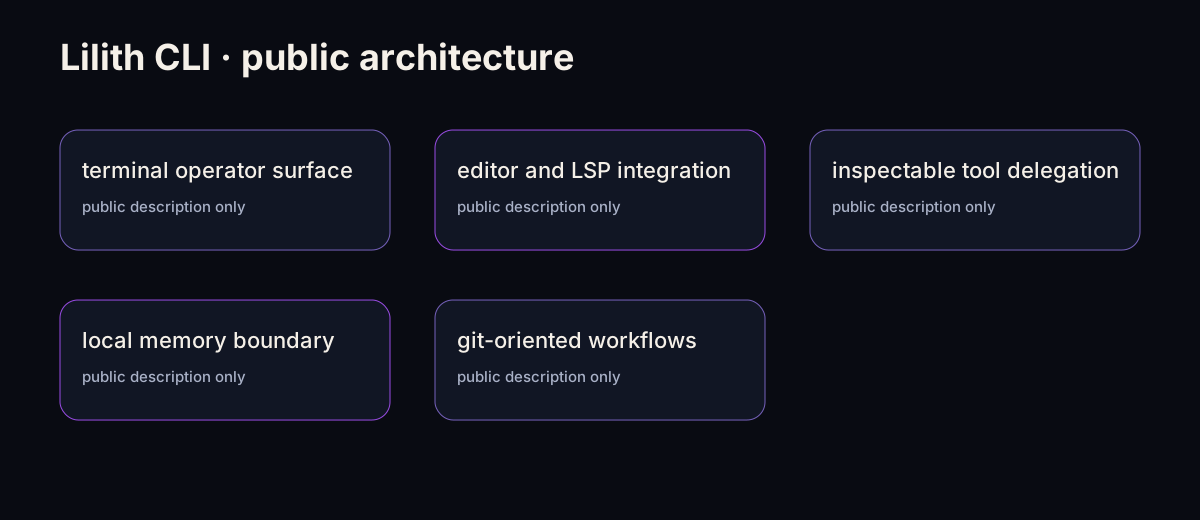
Human-facing terminal workspace and command surface.
Editing and language-aware development workflows.
Explicit, inspectable delegation to supported tools.
Local context support without making private Yggdrasil state public.
The public tool should remain useful without requiring a private remote control plane.
Tool and model handoffs should remain understandable to the operator.
Status: bounded
Open bounded Lab →Status: released
Public source →Public source repository
public-source-inspection · checked 2026-08-11 · fresh until 2026-09-10
Current public package version
public-package-source · checked 2026-08-11 · fresh until 2026-09-10
The public repository does not make the private Yggdrasil workspace public.
For a collaboration, describe what you are building, what is constrained and the result you need. Public prototypes and architecture pages are not a promise of a finished commercial service.