Problem
Agent ecosystems become unsafe to explain when documentation accidentally doubles as an operational control surface.
Private core · public architecture
Private nine-realm local ecosystem with a deliberately non-operational public architecture model.
Agent ecosystems become unsafe to explain when documentation accidentally doubles as an operational control surface.
Responsibilities are separated into bounded realms for agents, memory, interfaces, creative generation, tools, evidence and automation.
A public mental model for a private system, useful for understanding boundaries without creating a remote control plane.
The website verifies the disclosure boundary rather than claiming public access to the private implementation.
Selected case studies
Private nine-realm local ecosystem with a deliberately non-operational public architecture model.
Agent ecosystems become unsafe to explain when documentation accidentally doubles as an operational control surface.
Responsibilities are separated into bounded realms for agents, memory, interfaces, creative generation, tools, evidence and automation.
The website exposes architecture only: no remote execution, memory access, credentials or private clone path.
Verified Project State · 16.1
The website verifies the disclosure boundary rather than claiming public access to the private implementation.
Review due · Review window: 21 days
Source activity, the date of review and the website release are different events. A new website release does not renew this project’s evidence.
Open the dated state ledgerProject Intelligence 3 · 2026-08-18
Governed local orchestration, bounded realms, evidence-aware automation and reliable relay-backed workflows.
The public model now emphasizes authority boundaries and system relationships instead of operational access.
Updated 2026-08-18 · 21d freshness window
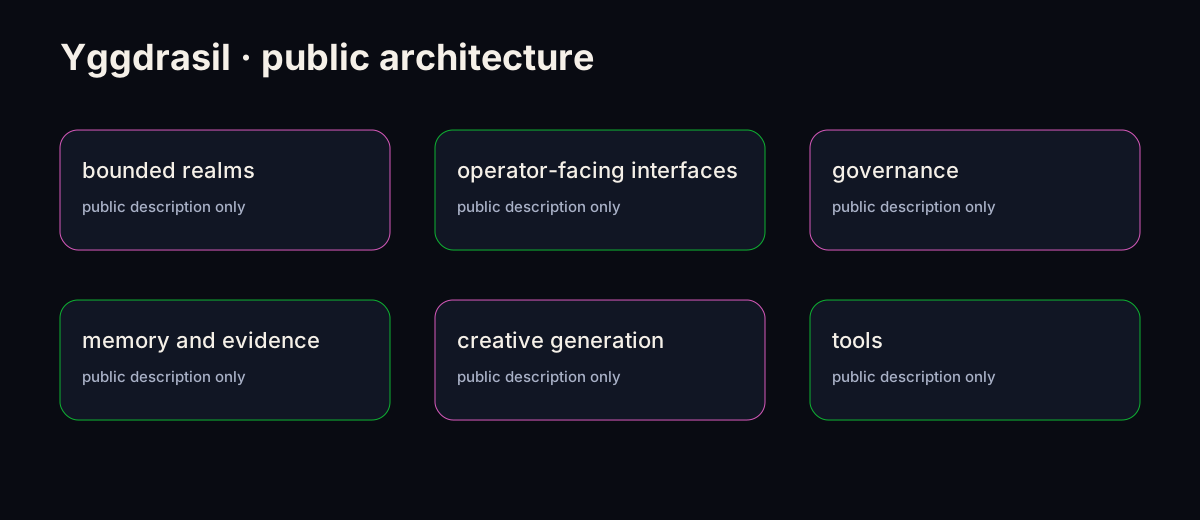
Governance, identity and authority boundaries.
Operator-facing applications and inspectable interfaces.
Knowledge and evidence boundaries.
Creative-generation responsibility without public datasets or endpoints.
Long-lived private persistence and memory.
Low-level tools and implementation surfaces.
Automation and auxiliary services.
Controlled model experimentation.
Visual and interface expression.
Distinct authority and responsibility boundaries are easier to inspect than one unrestricted agent surface.
The public site can explain the system without becoming a route into private execution or memory.
Status: bounded
Open bounded Lab →No project-specific public release record.
Architecture is public; execution, memory, credentials and source remain private
source-contract · checked 2026-08-11 · fresh until 2027-08-11
The website exposes architecture only: no remote execution, memory access, credentials or private clone path.
For a collaboration, describe what you are building, what is constrained and the result you need. Public prototypes and architecture pages are not a promise of a finished commercial service.